

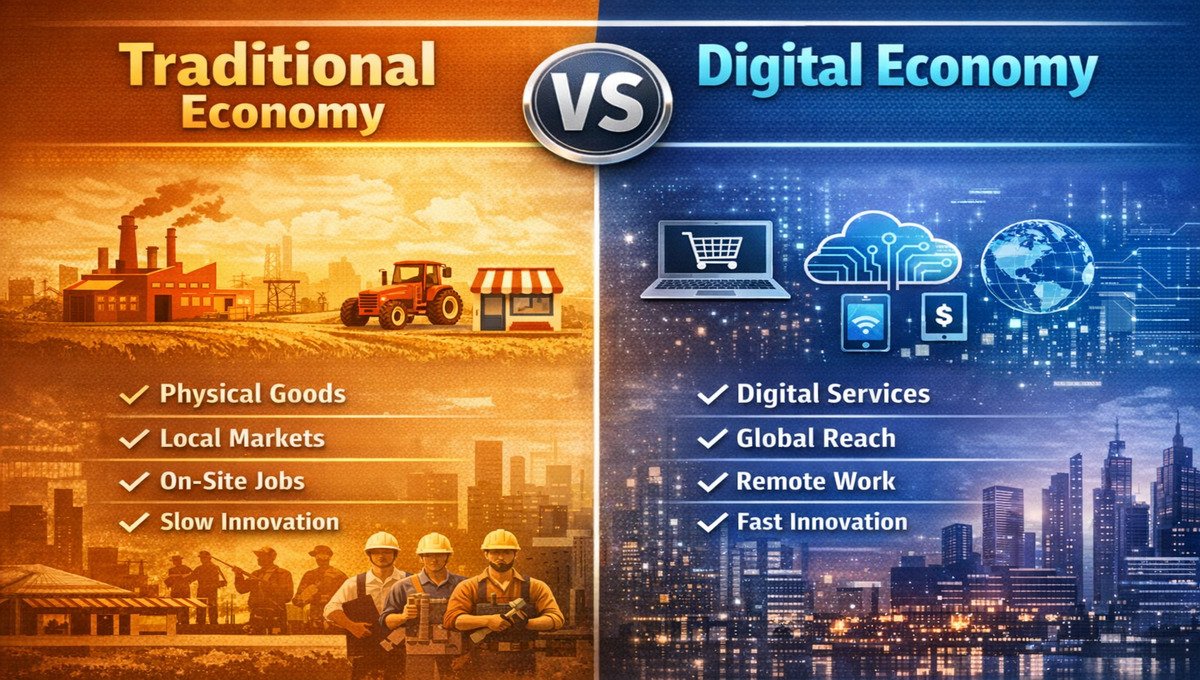

The global economy is experiencing a major transformation. For centuries, the traditional economy shaped how societies produced, traded, and consumed goods. Today, rapid technological advancement has fueled the rise of the digital economy, changing business models, labor structures, and value creation.
Understanding the differences between the traditional economy and the digital economy is essential for businesses, policymakers, students, and professionals navigating this shift.
What Is the Traditional Economy?
The traditional economy is built on physical resources, manual labor, and established business processes. It relies on tangible assets such as land, factories, machinery, and inventory. Industries like agriculture, manufacturing, construction, and brick-and-mortar retail are classic examples.
Economic activities are usually location-based, with businesses operating from physical offices or stores. Supply chains involve multiple intermediaries, transactions often take longer to complete, and innovation tends to be gradual within hierarchical organizational structures.
Despite technological disruption, this system remains critical, especially for infrastructure development, employment, and the production of essential goods.
What Is the Digital Economy?
The digital economy is powered by digital technologies such as the internet, cloud computing, artificial intelligence, big data, and mobile platforms. It includes e-commerce, fintech, digital marketing, software services, online education, and remote work platforms.
Unlike the traditional economy, the digital economy relies heavily on intangible assets such as data, algorithms, software, and intellectual property. Businesses can scale rapidly, reach global markets, and operate with minimal physical infrastructure.
This model enables faster innovation, automation, and personalized customer experiences, making it a dominant force in modern economic growth.
Comparison Table
| Aspect | Traditional Economy | Digital Economy |
| Core Basis | Physical goods and manual processes | Digital technologies and data-driven systems |
| Key Assets | Land, machinery, factories, inventory | Data, software, platforms, IP |
| Business Location | Location-dependent | Location-independent |
| Market Reach | Local or regional | Global |
| Speed of Operations | Slower, process-heavy | Fast, automated, real-time |
| Business Models | Linear (produce → distribute → sell) | Platform, subscription, service-based |
| Workforce Structure | On-site, full-time jobs | Remote work, freelancing, gig economy |
| Innovation Cycle | Slow and capital-intensive | Rapid and continuous |
| Customer Interaction | Offline, face-to-face | Digital and personalized |
| Cost Structure | High fixed and operating costs | Lower marginal costs, scalable |
Strengths and Limitations of Both Economies
The traditional economy provides stability, physical job opportunities, and well-established regulations. However, it can be less flexible, slower to innovate, and costly to scale.
The digital economy offers speed, efficiency, and global accessibility. At the same time, it faces challenges such as cybersecurity risks, data privacy concerns, regulatory gaps, and digital inequality.
Rather than replacing traditional systems, digital models often complement existing structures. Many industries now operate in hybrid models, blending physical operations with digital tools.
Why the Shift Matters
The transition from a traditional to a digital economy affects productivity, employment patterns, education, and economic competitiveness. Businesses that adapt to digital tools gain efficiency and market reach, while those that resist change risk becoming obsolete.
For governments and individuals, understanding this shift is key to developing relevant skills, policies, and long-term strategies.
Frequently Asked Questions (FAQ)
1. Is the traditional economy still relevant today?
Yes. It remains essential for physical goods, infrastructure, and large-scale employment.
2. What are examples of the digital economy?
E-commerce platforms, fintech apps, SaaS companies, digital marketing, and online education.
3. Does the digital economy replace jobs?
It changes job roles rather than eliminating them, creating new opportunities in tech and remote work.
4. Can traditional businesses enter the digital economy?
Absolutely. Many businesses adopt digital tools to improve operations and customer experience.
5. What does the future economy look like?
A hybrid economy combining traditional foundations with digital innovation.
Conclusion
The comparison of traditional vs digital economy is not about which is better—it’s about how they work together. The future lies in integration, where traditional industries adopt digital technologies to enhance efficiency, innovation, and resilience.
As global markets continue to evolve, adaptability will be the most valuable asset.
