

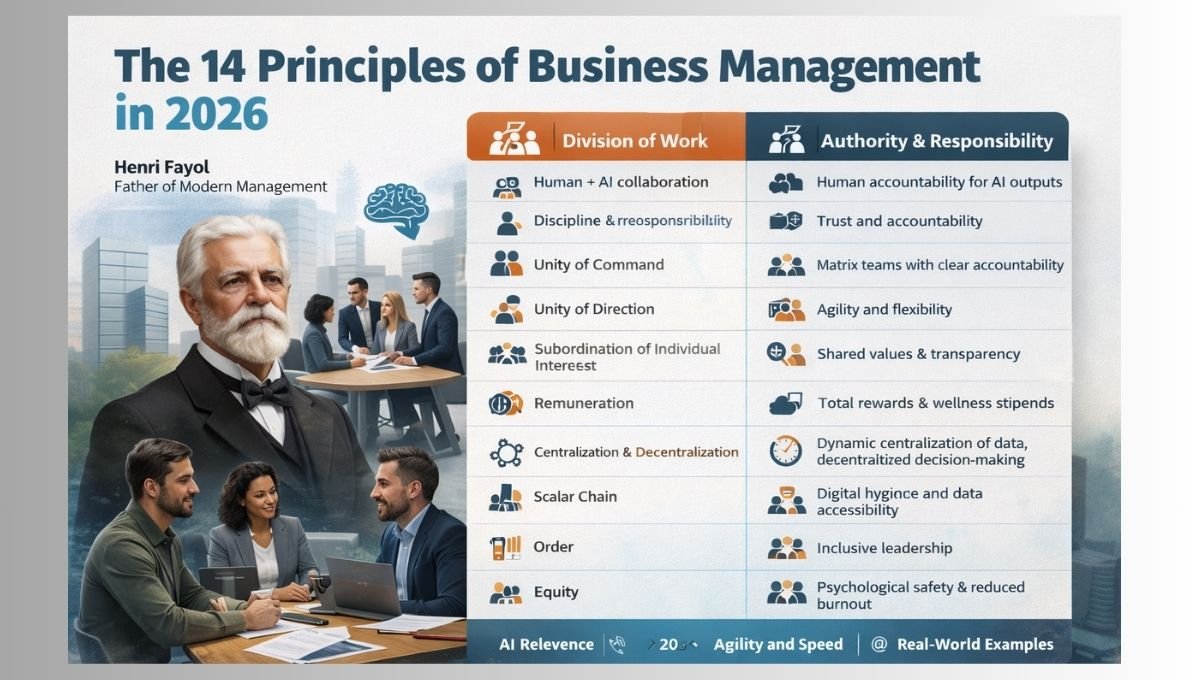

Henri Fayol, widely regarded as the father of modern management, introduced the principles of business management after years of real-world managerial experience. Even in 2026, these principles remain highly relevant, forming the foundation of effective leadership, organizational efficiency, and sustainable business growth.
Modern businesses—whether startups, large corporations, or distributed and asynchronous teams—still rely on these principles to manage people, processes, and performance successfully. While technology, AI, and remote work have reshaped how organizations operate, the human-centric logic behind Fayol’s principles remains timeless.
What Are the Principles of Business Management?
The principles of business management are fundamental guidelines that help managers plan, organize, direct, coordinate, and control business activities. These principles are not rigid rules; they are flexible in nature and can be adapted according to organizational size, industry, and changing business environments.
Their core purpose is to ensure:
- Efficient use of resources
- Clear authority and accountability
- Smooth coordination between teams
- Employee motivation, discipline, and engagement
The 14 Principles of Business Management (With 2026 Perspective)
1. Division of Work
Traditionally, division of work focused on specialization to improve efficiency and accuracy.
In 2026, specialization also includes Human + AI collaboration. Employees must know which tasks require human judgment and which can be delegated to automation or AI tools, leading to higher productivity and reduced burnout.
2. Authority and Responsibility
Authority gives managers the right to make decisions and issue instructions, while responsibility makes them accountable for results. Authority without responsibility leads to misuse of power, while responsibility without authority weakens management.
In modern organizations, accountability remains human—even when decisions are supported by AI systems.
3. Discipline
Discipline refers to obedience, respect for rules, and adherence to organizational policies.
In 2026, discipline is less about control and more about self-discipline, trust, and accountability, especially in remote and hybrid work environments.
4. Unity of Command
Each employee should receive orders from only one superior to avoid confusion and conflicting instructions.
However, modern matrix organizations and squad-based teams require managers to balance multiple stakeholders. The core principle still applies: clarity of responsibility must never be compromised, even if collaboration is multi-directional.
5. Unity of Direction
Activities with the same objective should be guided by one plan and one manager.
This principle ensures coordination among departments working toward common goals—especially important when teams are spread across locations and time zones.
6. Subordination of Individual Interest
The interests of the organization must take priority over individual interests. Personal goals should align with organizational objectives, not conflict with them.
In modern workplaces, this alignment is achieved through transparency, shared values, and outcome-based performance metrics.
7. Remuneration
Employees should receive fair wages, bonuses, and incentives. Proper remuneration boosts motivation, job satisfaction, and employee retention.
In 2026, remuneration goes beyond salary and includes total rewards such as:
- Flexible work hours
- Wellness benefits
- Learning budgets
- Performance equity and incentives
8. Centralization and Decentralization
Decision-making authority should be balanced. Strategic decisions remain centralized, while routine and operational decisions are delegated.
Modern organizations follow Dynamic Centralization—where data and insights are centralized as a single source of truth, but decision-making is decentralized to empower frontline teams.
9. Scalar Chain
The scalar chain represents the line of authority from top management to lower levels.
| Traditional View | 2026 Application |
| Top-down hierarchy | Flattened structures |
| Formal reporting lines | Instant communication via Slack, Teams, and dashboards |
The principle still ensures accountability, even when communication is faster and less formal.
10. Order (Material and Social)
Order means placing the right person in the right job and ensuring proper arrangement of resources.
In 2026, order includes digital hygiene—organized cloud systems, accessible data, secure workflows, and clear documentation—along with physical and human order.
11. Equity
Managers should treat employees with fairness, kindness, and respect. Equity builds trust, loyalty, and long-term commitment.
Modern equity also means inclusive leadership, unbiased systems, and equal growth opportunities across remote and in-office employees.
12. Stability of Tenure
Employees perform better when they feel secure. Traditionally, this meant long-term employment.
In the gig economy and fractional work era, stability of tenure focuses on psychological safety, reduced burnout, and meaningful continuity—even if roles or contracts evolve over time.
13. Initiative
Employees should be encouraged to share ideas and take initiative. This increases creativity, confidence, and ownership.
In 2026, organizations thrive when initiative is supported by experimentation, fast feedback loops, and innovation-friendly cultures.
14. Esprit de Corps
Esprit de corps means team spirit, unity, and harmony.
In a digital-first world, building team spirit requires intentional culture-building, virtual collaboration rituals, and strong internal communication—because teams are no longer always in the same room.
Importance of Principles of Business Management in 2026
In today’s fast-changing business environment, these principles help organizations:
- Improve efficiency and productivity
- Strengthen leadership and decision-making
- Maintain discipline and coordination
- Motivate and retain employees
- Achieve long-term business sustainability
A Note for 2026: The Role of Agility
While Fayol emphasized structure and stability, modern management in 2026 must be underpinned by Agility.
Organizations must be able to:
- Pivot their Unity of Direction quickly
- Reallocate responsibilities dynamically
- Respond to market and technological shifts overnight
Agility ensures that these principles remain practical—not rigid.
Are Fayol’s Principles Still Relevant in 2026?
Yes. Despite technological advancements, AI adoption, and new management models, Fayol’s principles remain relevant because they focus on human behavior, leadership balance, accountability, and teamwork—areas technology cannot replace.
They are widely applied in:
- Corporate management
- Startups and SMEs
- Remote and hybrid teams
- AI-driven and service-based businesses
Frequently Asked Questions (FAQs)
Who introduced the principles of business management?
They were introduced by Henri Fayol, a French management theorist.
How many principles of business management are there?
There are 14 principles of business management.
Which principle of management is the most important?
No single principle is most important. However, unity of command, discipline, and esprit de corps are often considered critical for effective management.
What is meant by esprit de corps?
Esprit de corps refers to team spirit, unity, trust, and cooperation among employees within an organization.
Why are principles of business management important for managers?
They help managers make better decisions, manage teams efficiently, reduce conflicts, and achieve organizational goals.
Can these principles be applied to AI-driven workflows?
Yes. Principles like Division of Work (defining what AI does versus humans) and Responsibility (humans remaining accountable for AI outputs) are more important than ever.
Conclusion
The 14 principles of business management continue to be a powerful framework for effective leadership in 2026 and beyond. When adapted with agility, technology awareness, and human-centered leadership, these principles help organizations balance authority with responsibility, maintain discipline, motivate employees, and ensure long-term success.
Applied consistently, they create not just efficient businesses—but resilient, future-ready organizations.
