



Introduction
Samsung Electronics is one of the most powerful technology companies in the world. The South Korean giant produces smartphones, memory chips, televisions, displays, and home appliances used by billions of people every day. For decades, Samsung has been known for its scale, ambition, and relentless ability to adapt to technological change.
But in recent years, one force above all others has transformed the company — artificial intelligence.
The global AI boom has dramatically increased demand for advanced semiconductors, especially High Bandwidth Memory (HBM) chips used in AI servers and data centres. Samsung sits at the heart of that supply chain. As AI spending surged worldwide, the company’s revenues, profits, and market value climbed sharply, pushing Samsung closer to the $1 trillion valuation milestone.
Yet while investors and executives benefited enormously from the AI revolution, many workers inside Samsung’s semiconductor business believed they were not receiving a fair share of the rewards.
Today — May 21, 2026 — the global AI industry narrowly avoided one of the biggest labour disruptions in semiconductor history after Samsung management and union leaders reached a dramatic last-minute tentative agreement.
The deal may have prevented a major supply chain crisis, but it also revealed something much larger: the workers powering the AI economy now hold more leverage than ever before.
How AI Changed Samsung’s Business
The rise of artificial intelligence reshaped the global semiconductor industry almost overnight.
Beginning in 2022 and accelerating through 2023, 2024, 2025, and now 2026, companies such as Google, Microsoft, Amazon, and Meta invested hundreds of billions of dollars into AI infrastructure.
Training and running advanced AI systems requires enormous quantities of high-performance memory chips. That demand turned HBM semiconductors into one of the most valuable products in the technology industry.
Samsung became one of the biggest beneficiaries of this shift.
The company’s advanced HBM chips are widely used in AI accelerators powered by NVIDIA GPUs, which currently dominate the AI hardware market. Samsung’s semiconductor fabs began operating under intense pressure as orders surged from cloud providers and AI companies around the world.
The financial impact was staggering.
Samsung recently reported quarterly profits more than 8.5 times higher than the same period a year earlier. Operating income from its memory chip division surged nearly 50-fold year over year, while demand for its latest HBM4 chips reportedly sold out most of the company’s 2026 production capacity within months.
Once considered a cyclical commodity business, memory chips have become the foundation of the global AI supply chain.
Why Samsung Workers Reached a Breaking Point
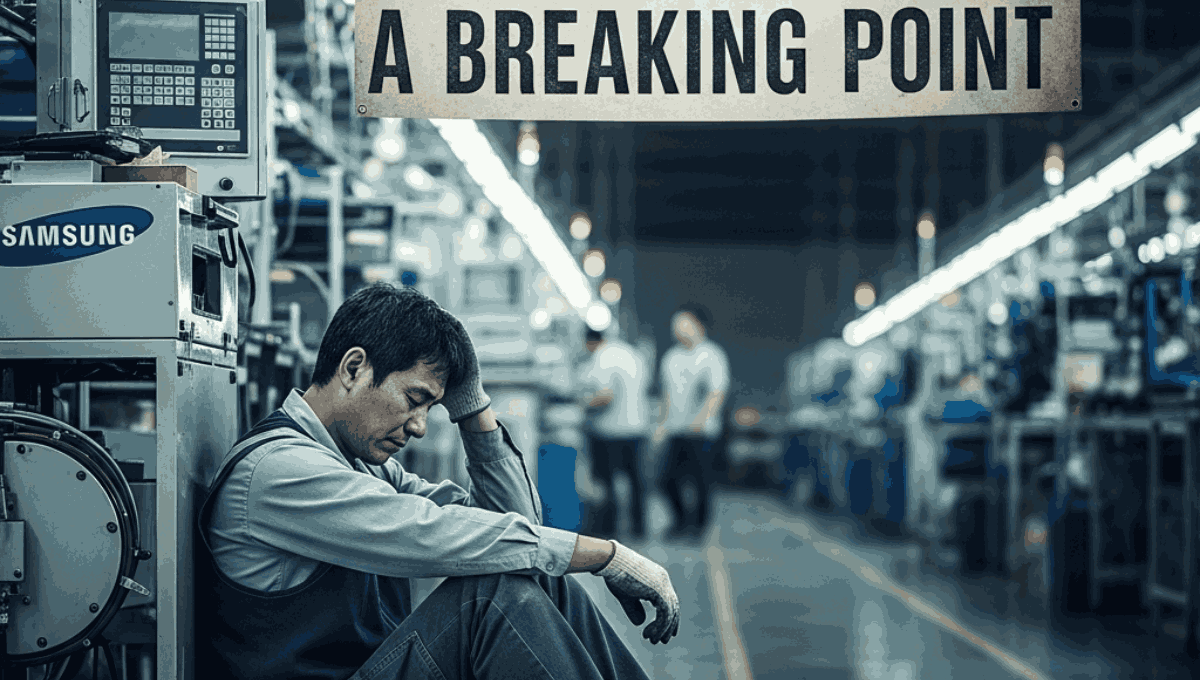
Samsung employs more than 270,000 people worldwide, including tens of thousands inside South Korea’s semiconductor fabrication plants.
These workers operate in highly controlled clean-room environments where even microscopic contamination can destroy chips worth thousands of dollars. Employees work rotating day and night shifts while handling increasingly aggressive production schedules tied directly to booming AI demand.
Many workers believed their compensation no longer reflected the profits generated by their labour.
Employees criticised Samsung’s long-standing bonus structure, which capped annual bonuses at 50% of base salary regardless of how profitable the company became. Workers also pointed to rising living costs and widening compensation gaps between Samsung and rival semiconductor firms.
Tensions intensified after rival chipmaker SK Hynix reached a landmark labour agreement in 2025 that eliminated bonus caps and allocated a significant share of profits directly to employees.
For Samsung workers, the comparison became impossible to ignore.
Key Numbers Behind Samsung’s AI Boom
| Category | Details |
| Workers involved in negotiations | 45,000+ |
| Planned strike duration | 18 days |
| Vote supporting industrial action | 95.52% |
| Increase in Samsung quarterly profits | More than 8.5x |
| Growth in memory division income | Nearly 50-fold |
| Original worker demand | 15% operating profit share |
| Tentative compromise | 10.5% operating profit share |
| Main AI product | HBM memory chips |
| Core AI partner ecosystem | AI servers powered by NVIDIA GPUs |
The 11th-Hour Deal That Saved the AI Supply Chain
On May 21, 2026, the global technology industry came remarkably close to a major semiconductor crisis.
A planned 18-day walkout involving roughly 45,000 unionised Samsung workers — threatening global supplies of AI-critical DRAM and High Bandwidth Memory chips — was suspended only hours before it was scheduled to begin.
According to reports, South Korean government mediators and labour officials stepped into emergency negotiations late in the evening as tensions escalated between management and union leaders. Just 90 minutes before midnight, both sides reached a historic tentative agreement.
Instead of walking off the production lines, workers will now vote on the proposed agreement between May 22 and May 27.
The near-strike highlighted how strategically important semiconductor workers have become in the AI era. Unlike disruptions in some other industries, interruptions in advanced chip production can ripple through the entire global technology ecosystem.
A prolonged shutdown at Samsung could have delayed AI server shipments, increased semiconductor prices, and slowed AI infrastructure expansion for major cloud providers around the world.
What the Historic Deal Includes
The tentative agreement includes several major concessions from Samsung management that would have seemed unlikely only a few years ago.
Samsung Agreed to Remove the Bonus Cap
One of the union’s biggest victories was the elimination of Samsung’s long-standing bonus ceiling, which previously capped payouts at 50% of annual salary.
Workers argued that fixed bonus limits no longer made sense during a period of extraordinary AI-driven profitability.
A Massive Profit-Sharing Agreement
While the union originally demanded 15% of annual operating profits, both sides reportedly settled on a compromise allocating 10.5% of annual operating profits toward employee bonuses.
That represents one of the most significant profit-sharing arrangements ever negotiated within the semiconductor industry.
The Memory vs. Logic Division Split
One of the most contentious issues during negotiations involved how the bonus pool would be distributed internally.
Under the tentative agreement:
| Division | Proposed Share of Bonus Pool |
| Memory chip division | 40% |
| Logic chip, foundry, and other units | 60% |
The structure reflects growing internal tensions within Samsung, where workers outside the booming memory division argued they were being left behind despite contributing to overall operations.
Bonuses Paid Largely Through Stock
To reduce immediate financial pressure on the company, a large portion of the special performance bonuses will reportedly be distributed in Samsung stock rather than direct cash payouts.
This approach allows Samsung to reward employees while limiting short-term cash flow disruption.
Analysts say the agreement could become a blueprint for future labour negotiations across the AI hardware industry as semiconductor profits continue climbing worldwide.
Why This Matters Beyond Samsung
The significance of this dispute extends far beyond a single company.
Artificial intelligence depends on physical infrastructure — semiconductor fabs, chip engineers, manufacturing workers, supply chains, and energy-intensive data centres. Without semiconductor workers, the AI revolution cannot scale.
That reality is beginning to reshape labour dynamics across the global technology industry.
Workers at companies such as Amazon and Tesla have already raised concerns about how AI-driven productivity gains and corporate profits are distributed. Semiconductor employees in Taiwan and South Korea are increasingly recognising the leverage they hold within the global economy.
For years, AI discussions focused almost entirely on software, algorithms, and billion-dollar valuations. But Samsung’s near-strike revealed something equally important: the future of AI also depends on the people physically building the hardware behind it.
Conclusion
Samsung’s rise toward a trillion-dollar valuation reflects years of technological investment, engineering innovation, and strategic execution. But it also reflects the labour of thousands of semiconductor workers whose efforts power the global AI economy.
This week, those workers demonstrated just how much influence they now possess.
A strike that could have disrupted one of the world’s most important AI supply chains was avoided only through major concessions from one of the largest technology companies on Earth.
The message reaching the broader tech industry is becoming increasingly clear:
The AI boom is generating enormous wealth, and workers want a larger share of it.
As artificial intelligence continues transforming the global economy, the biggest question may no longer be how powerful AI becomes — but how the wealth created by AI is ultimately shared.
Frequently Asked Questions (FAQ)
Why were Samsung Electronics workers planning to strike?
Samsung workers were preparing for an 18-day strike over compensation, profit-sharing, and bonus policies. Employees argued that their pay had not kept pace with the company’s massive AI-driven profit growth, especially within its semiconductor division.
What caused Samsung’s profits to surge?
Samsung benefited heavily from the global artificial intelligence boom. Demand for High Bandwidth Memory (HBM) chips and AI semiconductors increased sharply as companies such as Google, Microsoft, and Meta expanded AI infrastructure and data centres worldwide.
What are HBM chips and why are they important?
HBM (High Bandwidth Memory) chips are advanced memory semiconductors used in AI accelerators and high-performance computing systems. These chips help process massive amounts of data quickly, making them essential for training and running modern AI models.
How did the Samsung labour dispute affect the AI industry?
A large-scale strike at Samsung could have disrupted global supplies of AI-critical memory chips, delayed AI server production, increased semiconductor prices, and slowed AI infrastructure expansion across the technology industry.
What did Samsung workers gain from the tentative agreement?
According to reports, the tentative agreement includes:
- Removal of the 50% bonus cap
- A 10.5% operating profit-sharing structure
- Revised internal bonus distribution between divisions
- Large stock-based performance payouts
Workers are expected to vote on the agreement between May 22 and May 27, 2026.
Why is SK Hynix important in this story?
SK Hynix became a major comparison point after reaching a landmark labour agreement in 2025 that removed bonus caps and shared more profits directly with employees. Samsung workers pointed to that deal while demanding similar treatment.
Could this agreement influence other technology companies?
Yes. Analysts believe Samsung’s tentative agreement could become a model for future labour negotiations across the AI hardware and semiconductor industry as workers seek a larger share of AI-generated profits.
Why is Samsung important to the global AI supply chain?
Samsung is one of the world’s largest semiconductor manufacturers and a major producer of HBM memory chips used in AI servers and data centres. Many AI systems powered by NVIDIA GPUs depend on Samsung’s semiconductor technology.
For More Information Visit:- businesslyf
