

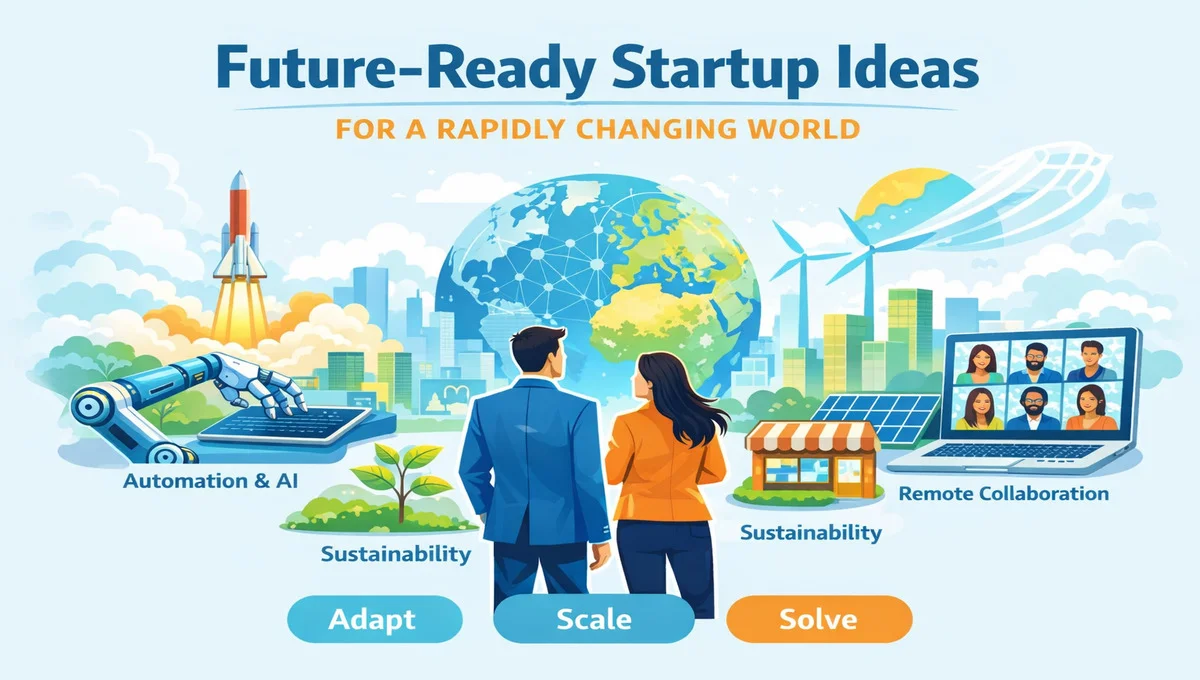

The pace of change has never been faster. Advances in technology, shifting consumer expectations, global economic uncertainty, and evolving work cultures are reshaping how people live and do business. In this environment, traditional startup ideas are no longer enough. To succeed long-term, entrepreneurs must think ahead and build solutions designed not just for today, but for the future.
Future-ready startup ideas focus on adaptability, resilience, and real-world impact. They anticipate change rather than react to it. This blog explores what makes a startup future-ready, the key trends driving opportunity, and how founders can position their ideas for long-term success in a rapidly changing world.
What Does “Future-Ready” Really Mean?
A future-ready startup is built with flexibility at its core. It can evolve as markets shift, technologies advance, and customer needs change. Rather than depending on a single trend, these startups solve fundamental problems that will remain relevant for years to come.
Future-ready startups typically share three characteristics:
- Adaptable business models that can pivot without collapsing
- Scalable solutions that grow alongside demand
- Technology awareness without over-reliance on hype
Being future-ready isn’t about predicting the future perfectly—it’s about being prepared for multiple possible futures.
The Global Forces Shaping Startup Opportunities
Several large-scale changes are influencing where the best startup ideas emerge. Understanding these forces helps founders identify opportunities with staying power.
Digital acceleration continues to transform nearly every industry. Automation, AI, and data-driven decision-making are becoming expectations rather than advantages.
Remote and hybrid work models are now permanent for many organizations, creating demand for tools that support distributed teams, mental well-being, productivity, and digital collaboration.
Sustainability and climate awareness are no longer optional. Consumers and businesses increasingly favor solutions that reduce waste, save energy, and promote responsible practices.
Demographic shifts, including aging populations and digitally native generations, are changing how products and services must be designed and delivered.
Startups that align with these forces are better positioned to stay relevant as the world evolves.
Future-Ready Startup Idea Categories
Rather than focusing on specific products, it’s often more useful to think in terms of categories where future-ready ideas thrive.
1. Automation and Efficiency Tools
Businesses everywhere are under pressure to do more with less. Startups that automate repetitive tasks, reduce operational friction, or simplify complex workflows will continue to be in demand.
2. Human-Centered Technology
As technology becomes more pervasive, people crave tools that enhance—not replace—human experience. This includes mental health platforms, learning tools, and systems that support creativity and well-being.
3. Sustainable Innovation
From circular economy platforms to energy-saving software, startups that help individuals and companies operate more sustainably will see growing demand and regulatory support.
4. Digital Infrastructure for Small Businesses
While large enterprises have access to advanced tools, small businesses often struggle. Startups that provide affordable, easy-to-use digital infrastructure can unlock massive global markets.
Building for Uncertainty Instead of Certainty
One of the biggest mistakes founders make is designing startups for a single scenario. The future rarely unfolds as expected. Future-ready startups embrace uncertainty by building modular products and listening closely to user feedback.
This means:
- Launching with a strong core feature instead of a bloated product
- Continuously testing assumptions
- Designing systems that can integrate new technologies later
Startups that survive market shifts are usually not the ones with the best predictions, but the ones with the fastest learning cycles.
The Role of Technology Without Chasing Trends
Emerging technologies create opportunity, but chasing trends blindly can be risky. Being future-ready doesn’t mean using the newest technology—it means using the right technology at the right time.
Successful startups ask:
- Does this technology genuinely improve the solution?
- Can it scale reliably?
- Will it still be relevant in five years?
Technology should serve the problem, not define it. Many enduring companies adopt new technologies gradually while maintaining a clear focus on customer value.
Preparing Your Startup for Long-Term Growth
Future-ready founders think beyond launch day. They design for longevity by building strong foundations early.
This includes:
- Clear value propositions that don’t depend on short-term hype
- Ethical decision-making and data responsibility
- Strong customer relationships and trust
Startups that invest in trust, transparency, and long-term thinking often outperform those chasing rapid but fragile growth.
Final Thoughts
A rapidly changing world doesn’t make entrepreneurship harder—it makes it more meaningful. The startups that will thrive are those that solve real problems while staying flexible, responsible, and forward-looking.
Future-ready startup ideas are not about guessing what comes next. They are about building adaptable solutions rooted in human needs and global realities. For entrepreneurs willing to think long-term, the future offers not uncertainty, but opportunity.
