


Every successful business decision starts with understanding the market. Whether you are launching a startup, expanding a product line, or exploring opportunities on trending business sites, knowing what your customers want can make the difference between growth and failure. This is where market research methods become essential.
Businesses today operate in highly competitive environments where guessing is risky and expensive. Instead of relying on assumptions, companies collect and analyze real data about customers, competitors, and industry trends. From simple surveys to advanced analytics tools, market research provides the insights needed to make smarter decisions.
For entrepreneurs, marketers, and investors, learning how market research works is not just helpful—it’s critical. In this guide, you’ll discover 15 powerful market research methods, how they work, their advantages, and real-world examples that show how businesses use them to stay ahead in competitive markets.
What Are Market Research Methods?
Market research methods are techniques businesses use to collect and analyze information about customers, competitors, and market trends. These methods—such as surveys, interviews, competitor analysis, and social listening—help companies understand consumer behavior, validate product ideas, and make data-driven decisions that reduce risk and improve business performance.
Why Market Research Matters for Businesses
Before exploring the techniques themselves, it’s important to understand why businesses invest heavily in research.
Market research provides clarity in areas where assumptions can lead to costly mistakes.
Key Benefits of Market Research
- Understand customer needs before launching products
- Identify market opportunities and gaps
- Reduce financial risk in business decisions
- Improve marketing strategies
- Analyze competitor performance
According to a CB Insights startup failure report, nearly 35% of startups fail because there is no real market demand for their product. Effective market research helps avoid this common mistake.
For entrepreneurs exploring trending business sites or business directories, research also reveals which industries are growing and where investment opportunities exist.
Types of Market Research
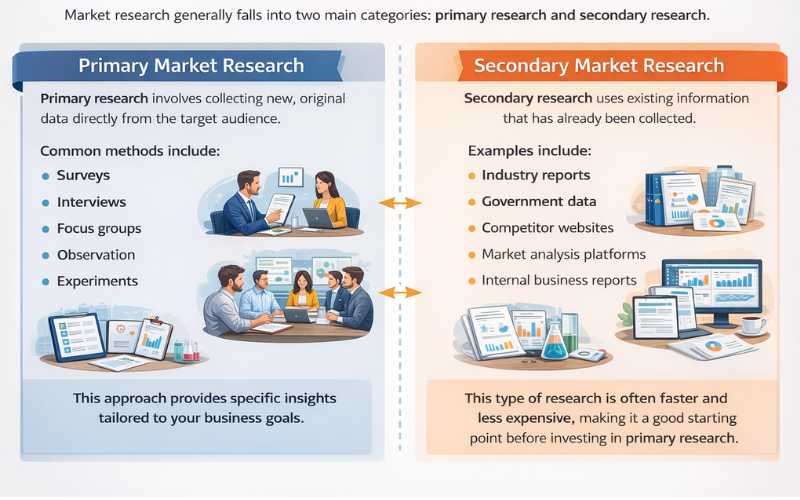
Market research generally falls into two main categories: primary research and secondary research.
Primary Market Research
Primary research involves collecting new, original data directly from the target audience.
Common methods include:
- Surveys
- Interviews
- Focus groups
- Observation
- Experiments
This approach provides specific insights tailored to your business goals.
Secondary Market Research
Secondary research uses existing information that has already been collected.
Examples include:
- Industry reports
- Government data
- Competitor websites
- Market analysis platforms
- Internal business reports
This type of research is often faster and less expensive, making it a good starting point before investing in primary research.
15 Powerful Market Research Methods (With Real Examples)
Below are some of the most effective techniques businesses use today.
| SR. No. | Market Research Method | Description | Example / Use Case | Benefits | Drawbacks / Limitations |
| 1 | Surveys | Structured questionnaires to collect quantitative and qualitative data from customers. | E-commerce company asking customers which product features they value most. | Large sample size, easy to analyze, scalable | Response bias, requires careful question design |
| 2 | Customer Interviews | One-on-one conversations to understand motivations, preferences, and frustrations. | Startup founder interviewing early users to learn why they chose a competitor. | Deep insights, qualitative data | Time-consuming, small sample size |
| 3 | Focus Groups | Small group discussions to gather opinions and emotional reactions about a product or concept. | Testing branding or advertising campaigns. | Interactive, uncovers group opinions | Moderator bias, difficult to schedule |
| 4 | Observational Research | Watching customer behavior in real-life situations instead of asking questions. | Retail stores observing how shoppers navigate aisles. | Reveals actual behavior, uncovers unspoken patterns | Can be resource-intensive, requires careful interpretation |
| 5 | Experiments & A/B Testing | Testing different variations of a product, website, or marketing campaign to find best results. | Website testing two landing page versions for sign-ups. | Direct comparison, measurable results | Artificial conditions may affect real-world behavior |
| 6 | Field Trials | Testing products in real-world conditions before full launch. | Food companies distributing samples in select markets. | Real-world feedback, minimizes launch risks | Expensive, time-consuming |
| 7 | Social Media Listening | Monitoring social media, forums, and review sites for brand mentions and trends. | Tracking sentiment on top trending business websites. | Real-time insights, trend spotting | Online audience may not represent full market |
| 8 | Competitor Analysis | Studying competitors’ products, pricing, marketing strategies, and market position. | Using business directory platforms to identify competitors. | Understand competition, identify market gaps | Limited by publicly available information |
| 9 | Desk Research | Analyzing existing reports, studies, and statistics. | Reviewing market reports, government data, academic studies. | Cost-effective, quick context | Data may be outdated or incomplete |
| 10 | Purchased Market Data | Buying detailed market reports from professional research firms. | Accessing consumer behavior trends, industry forecasts, and segmentation insights. | High-quality data, ready-to-use insights | Expensive, limited control over data collection |
| 11 | Mystery Shopping | Researchers experience services as regular customers to evaluate performance. | Evaluating service quality, employee performance, store environment. | First-hand insights, evaluates customer experience | Expensive, relies on consistency of shoppers |
| 12 | Website Analytics | Tracking visitor behavior on websites using analytics tools. | Analyzing page views, bounce rates, and user journey on trending business sites. | Data-driven insights, measurable KPIs | Requires technical setup, may miss offline behavior |
| 13 | Customer Reviews Analysis | Studying online reviews to gather feedback about products or services. | Analyzing feedback from e-commerce stores or app marketplaces. | Real customer opinions, identifies improvement areas | Reviews may be biased or incomplete |
| 14 | Search Trend Analysis | Using tools to track what people are searching for online. | Entrepreneurs analyzing search trends to find rising industries. | Reveals emerging opportunities, helps strategy | Only shows intent, not actual purchase behavior |
| 15 | Online Community Research | Observing forums, discussion groups, and niche communities for consumer insights. | Studying discussions in professional groups or niche communities. | Honest, unfiltered feedback | Time-consuming, may require validation of insights |
1. Surveys
Surveys are one of the most popular market research methods because they can collect information from large audiences quickly.
Businesses ask structured questions to understand customer preferences, satisfaction, and buying behavior.
Example:
An e-commerce company might send surveys to customers asking which product features they value most.
Benefits
- Large sample size
- Easy to analyze data
- Scalable for global audiences
Drawbacks
- Response bias
- Requires careful question design
2. Customer Interviews
Interviews involve one-on-one conversations with customers.
These discussions uncover deep insights into motivations and frustrations.
Example:
A startup founder interviewing early users to understand why they chose a competitor.
3. Focus Groups
Focus groups bring together small groups of participants to discuss a product or concept.
This method helps uncover emotional reactions and group opinions.
Companies often use focus groups to test branding or advertising campaigns.
4. Observational Research
Instead of asking customers questions, businesses observe how customers behave in real-life situations.
Example:
Retail stores observing how shoppers navigate aisles.
This method reveals behavior patterns customers may not mention in surveys.
5. Experiments and A/B Testing
Experiments allow businesses to test different variations of a product, marketing campaign, or website design.
Example:
A website testing two versions of a landing page to see which one generates more sign-ups.
6. Field Trials
Field trials test products in real-world conditions before a full launch.
For example, food companies often distribute samples in select markets to gather feedback.
7. Social Media Listening
Social listening monitors conversations on platforms like social media, forums, and review sites.
Businesses track:
- Brand mentions
- Customer complaints
- Industry trends
This method helps companies identify trends on top trending business websites and understand audience sentiment.
8. Competitor Analysis
Competitor research examines how rival companies operate.
Businesses analyze:
- Pricing strategies
- Product offerings
- marketing campaigns
Entrepreneurs often use business directory platforms to identify competitors and study their market position.
9. Desk Research
Desk research analyzes existing information such as reports, studies, and industry statistics.
It’s one of the most cost-effective research methods.
Example sources include:
- Market reports
- Government data
- Academic publications
10. Purchased Market Data
Some organizations purchase research data from professional market research firms.
These reports often include:
- consumer behavior trends
- industry forecasts
- market segmentation insights
11. Mystery Shopping
Mystery shopping evaluates customer experiences by sending researchers to interact with businesses as regular customers.
This method helps evaluate:
- service quality
- employee performance
- store environment
12. Website Analytics
Website analytics tools track how visitors interact with websites.
Important metrics include:
- page views
- bounce rate
- user journey
Businesses often analyze these insights while studying trending business sites to understand successful digital strategies.
13. Customer Reviews Analysis
Online reviews provide valuable insights into customer satisfaction.
Companies study feedback from platforms like:
- e-commerce stores
- app marketplaces
- review platforms
These insights reveal common issues and opportunities for improvement.
14. Search Trend Analysis
Tools like search trend platforms help businesses track what people are searching for online.
For example, entrepreneurs exploring top trending business websites often analyze search trends to identify rising industries.
15. Online Community Research
Forums, discussion groups, and online communities provide honest opinions about products and industries.
Popular sources include:
- community forums
- niche communities
- professional groups
These conversations reveal unfiltered consumer insights.
Qualitative vs Quantitative Research
Market research methods usually fall into two categories:
| Research Type | Focus | Example |
| Qualitative | Understand motivations | Interviews |
| Quantitative | Measure numbers and patterns | Surveys |
Successful research often combines both approaches.
For example:
- Interviews reveal why customers behave a certain way
- Surveys confirm whether the behavior applies to a larger audience
How Businesses Choose the Right Research Method
Selecting the right method depends on several factors.
1. Research Goals
The first step is defining what you want to learn.
For example:
- Understanding customer needs
- Testing product ideas
- Evaluating competitors
2. Budget
Some methods like focus groups or field trials require significant investment.
Desk research and surveys are often more affordable.
3. Time
If quick insights are needed, surveys or analytics tools are ideal.
Deep research methods like interviews require more time.
4. Data Accuracy
Reliable insights require representative audiences and unbiased questions.
Real-World Examples of Market Research in Action
Many successful companies rely heavily on market research.
Amazon
Amazon uses customer data and behavioral analysis to recommend products and improve shopping experiences.
Netflix
Netflix analyzes viewing patterns to decide which shows to produce or recommend.
These examples show how research helps companies answer critical questions like:
“Which reason to invest resonates the most with you? Why?”
Understanding consumer motivations allows companies to design better products and marketing strategies.
Practical Tips for Conducting Effective Market Research
If you’re planning to conduct research for your business, consider these strategies:
- Start with secondary research to understand the market landscape.
- Use multiple research methods to validate findings.
- Focus on clear and unbiased questions.
- Ensure your sample audience represents your target market.
- Combine data analysis with real customer feedback.
Career Opportunities in Market Research
Market research has become a fast-growing career field.
Common roles include:
- Market Research Analyst
- Consumer Insights Specialist
- Business Intelligence Analyst
- Data Analyst
- Marketing Strategist
According to the U.S. Bureau of Labor Statistics, the demand for market research analysts is expected to grow steadily as companies rely more on data-driven decision-making.
Frequently Asked Questions (FAQs)
What are the most common market research methods?
The most common methods include surveys, interviews, focus groups, observation, and competitor analysis. Businesses often combine these techniques to gather both quantitative data and qualitative insights.
What is the difference between primary and secondary research?
Primary research collects original data directly from customers, while secondary research uses existing information such as industry reports, competitor websites, and internal data sources.
Why do businesses conduct market research?
Businesses conduct research to understand customer behavior, reduce risks, identify opportunities, and improve decision-making.
Which market research method is best for startups?
Surveys, interviews, and competitor analysis are often the most practical for startups because they are affordable and provide valuable insights quickly.
Conclusion
In today’s competitive environment, businesses cannot rely on guesswork. Market research methods provide the data and insights needed to understand customers, evaluate competitors, and identify opportunities for growth.
From surveys and interviews to analytics tools and social listening, these 15 techniques help companies make informed decisions and reduce risks. By combining multiple methods and analyzing both qualitative and quantitative data, businesses can gain a deeper understanding of their markets.
Whether you’re an entrepreneur exploring opportunities on trending business sites, analyzing competitors in a business directory, or evaluating investment decisions, effective market research is the foundation of smart strategy and sustainable business success.
