

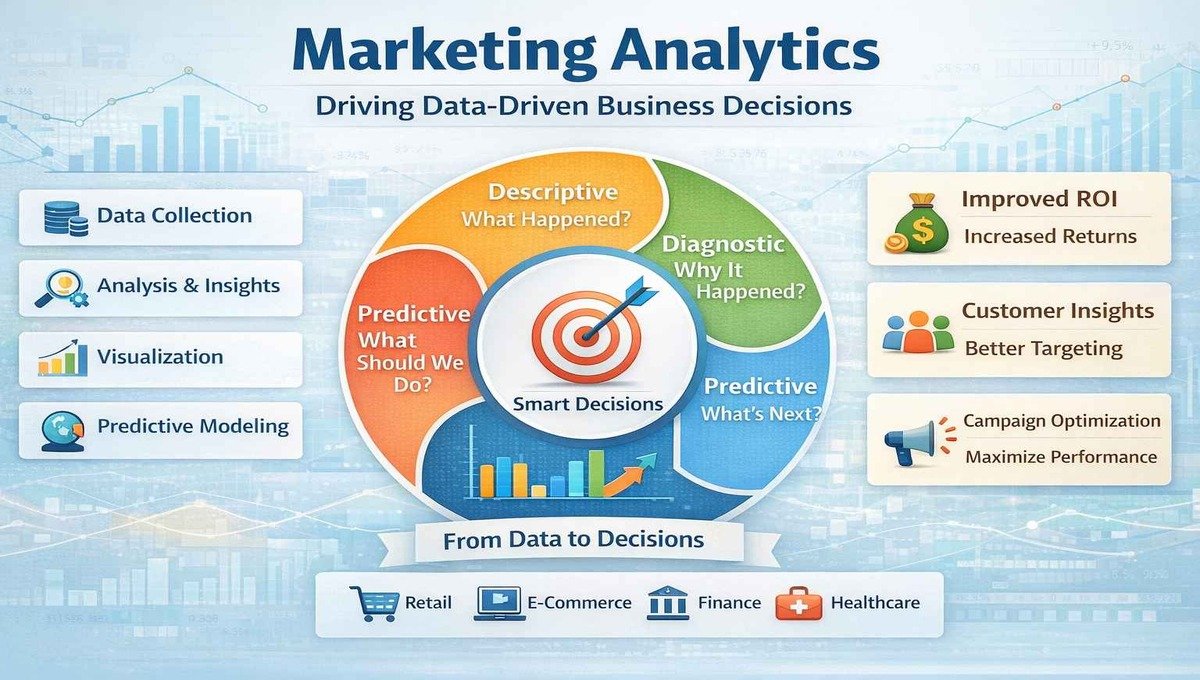

In today’s fast-paced digital world, businesses can no longer rely on intuition alone to make marketing decisions. With customers interacting across multiple platforms—websites, social media, mobile apps, and email—massive amounts of data are generated every second. This is where Marketing Analytics plays a crucial role. By transforming raw data into meaningful insights, marketing analytics empowers organizations to make data-driven business decisions that improve performance, efficiency, and return on investment (ROI).
What Is Marketing Analytics?
Marketing analytics refers to the practice of measuring, managing, and analyzing marketing performance data to maximize effectiveness and optimize outcomes. It involves collecting data from various marketing channels and using analytical techniques to understand customer behavior, campaign performance, and market trends.
Rather than asking “What do we think will work?”, marketing analytics answers “What does the data tell us will work?” This shift from intuition-based to evidence-based decision-making is what makes analytics so powerful.
Why Marketing Analytics Matters
The importance of marketing analytics lies in its ability to reduce uncertainty. Businesses invest heavily in marketing campaigns, and without analytics, it becomes difficult to know which strategies are delivering results and which are wasting resources.
Key benefits include:
- Improved decision-making based on factual insights
- Better customer understanding through behavioral analysis
- Optimized marketing spend by focusing on high-performing channels
- Measurable ROI for campaigns and initiatives
Organizations that effectively use marketing analytics are more agile, competitive, and customer-centric.
Key Components of Marketing Analytics
1. Data Collection
Data is gathered from multiple sources such as websites, CRM systems, social media platforms, email campaigns, and paid advertisements. Tools like Google Analytics, Power BI, and CRM dashboards help centralize this information.
2. Data Cleaning and Preparation
Raw data is often incomplete or inconsistent. Cleaning and structuring the data ensures accuracy and reliability before analysis begins.
3. Data Analysis
This stage involves applying statistical methods, dashboards, and models to uncover trends, correlations, and patterns. Techniques such as segmentation, funnel analysis, and cohort analysis are commonly used.
4. Visualization and Reporting
Data visualization tools transform complex datasets into easy-to-understand charts, graphs, and dashboards. This helps stakeholders quickly grasp insights and take action.
Types of Marketing Analytics
Marketing analytics can be categorized into four main types:
- Descriptive Analytics: Explains what happened (e.g., website traffic, campaign reach).
- Diagnostic Analytics: Identifies why something happened (e.g., drop in conversions).
- Predictive Analytics: Forecasts future outcomes using historical data (e.g., sales predictions).
- Prescriptive Analytics: Recommends actions to achieve optimal results (e.g., budget allocation).
Together, these types support smarter and more proactive business decisions.
Marketing Analytics in Business Decision-Making
Marketing analytics directly influences strategic and operational decisions. For example:
- Determining which customer segments are most profitable
- Identifying the best-performing marketing channels
- Personalizing content and offers to improve engagement
- Optimizing pricing and promotions
By aligning marketing insights with business objectives, companies can ensure that every decision contributes to long-term growth.
Real-World Applications
Businesses across industries use marketing analytics in practical ways:
- Retail companies analyze purchase patterns to improve product recommendations
- E-commerce platforms optimize conversion rates through A/B testing
- Financial services use analytics to reduce customer churn
- Healthcare and education institutions improve outreach and enrollment strategies
These applications demonstrate how analytics bridges the gap between data and action.
Challenges in Marketing Analytics
Despite its advantages, marketing analytics comes with challenges:
- Data silos across departments
- Poor data quality
- Lack of skilled analysts
- Difficulty in translating insights into action
Overcoming these challenges requires the right tools, skilled teams, and a strong data-driven culture.
The Future of Marketing Analytics
The future of marketing analytics is closely tied to artificial intelligence and machine learning. Automated insights, real-time dashboards, predictive modeling, and personalization at scale are becoming the norm. As privacy regulations evolve, ethical data usage and transparency will also play a vital role.
Organizations that invest in advanced analytics capabilities today will be better positioned to adapt and innovate tomorrow.
Frequently Asked Questions (FAQs)
1. What is the main goal of marketing analytics?
The primary goal of marketing analytics is to measure marketing performance and use data-driven insights to improve decision-making and ROI.
2. What tools are commonly used in marketing analytics?
Popular tools include Google Analytics, Tableau, Power BI, Excel, SQL, and CRM platforms like Salesforce.
3. How does marketing analytics help businesses grow?
It helps identify customer needs, optimize campaigns, reduce costs, and improve targeting—leading to higher revenue and customer satisfaction.
4. Is marketing analytics only for large companies?
No. Small and medium-sized businesses can also benefit by using basic analytics tools to make smarter marketing decisions.
5. What skills are needed for marketing analytics?
Key skills include data analysis, statistics, SQL, data visualization, business understanding, and critical thinking.
Conclusion
Marketing analytics is no longer optional—it is a necessity for businesses aiming to compete in a data-driven economy. By leveraging marketing analytics, organizations can move beyond guesswork, make informed decisions, and drive measurable business outcomes. Ultimately, marketing analytics turns data into a strategic asset that fuels smarter decisions and sustainable growth.
