



Cash flow is the lifeblood of any business. Even profitable companies can fail if cash isn’t moving in and out at the right time. Poor cash flow management leads to delays in paying suppliers, difficulty covering payroll, and missed growth opportunities.
The good news is that improving cash flow doesn’t always require major investment or complex systems. In many cases, small but strategic changes can deliver fast results.
In this blog, we’ll explore 10 proven strategies to boost business cash flow quickly, helping you stabilize your finances and create more breathing room for growth.
1. Speed Up Customer Payments
One of the fastest ways to improve cash flow is to get paid faster.
Many businesses suffer because they offer long payment terms (like 30, 60, or even 90 days). While this may attract customers, it can strain your cash reserves.
How to improve:
- Send invoices immediately after delivering goods or services
- Use digital invoicing systems for faster delivery
- Offer multiple payment options (UPI, cards, bank transfers)
- Set clear due dates and late payment penalties
Even reducing payment time by a few days can significantly improve liquidity.
2. Offer Early Payment Discounts
Encouraging customers to pay early can bring cash into your business faster.
For example, offering a 2% discount if payment is made within 10 days instead of 30 days can motivate quicker settlements.
Benefits:
- Faster access to cash
- Reduced credit risk
- Improved customer relationships
This strategy works especially well for B2B businesses with large invoice cycles.
3. Reduce Unnecessary Expenses
Cutting costs is one of the most direct ways to improve cash flow.
Steps to take:
- Review monthly subscriptions and cancel unused services
- Negotiate better deals with suppliers
- Switch to more cost-effective tools or vendors
- Reduce energy and operational waste
Even small savings across multiple areas can add up quickly, improving your available cash.
4. Maintain a Cash Flow Forecast
A cash flow forecast helps you predict when money will come in and go out.
Without forecasting, businesses often face unexpected shortages.
Why it matters:
- Helps avoid cash shortages
- Improves planning for expenses
- Supports better decision-making
Simple method:
Create a monthly or weekly spreadsheet tracking:
- Incoming payments
- Fixed expenses
- Variable costs
This allows you to identify gaps before they become problems.
5. Improve Inventory Management
Excess inventory ties up cash that could be used elsewhere.
If products sit unsold for too long, your money is essentially frozen.
Solutions:
- Use just-in-time inventory systems
- Track slow-moving products
- Run promotions to clear old stock
- Avoid over-ordering based on assumptions
Efficient inventory management keeps cash circulating in your business.
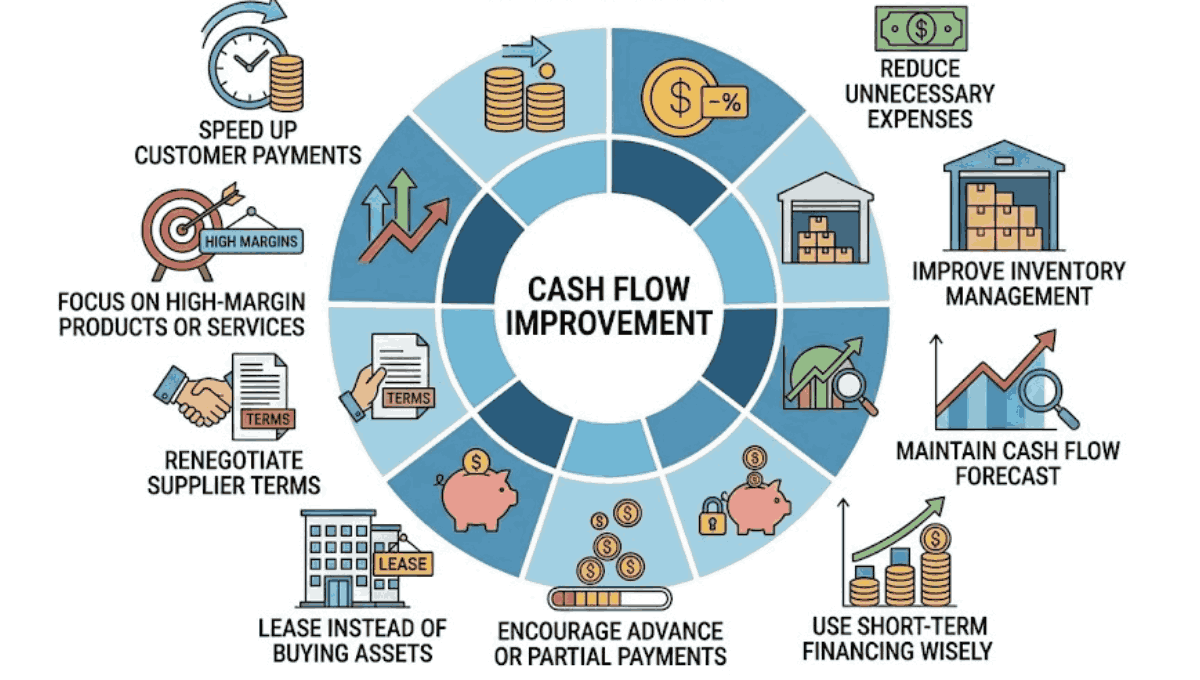
6. Renegotiate Supplier Terms
Your suppliers can significantly impact your cash flow.
If you are paying suppliers faster than you receive payments from customers, cash flow issues are inevitable.
What you can do:
- Request longer payment terms (e.g., from 15 to 30 or 45 days)
- Negotiate bulk purchase discounts
- Build strong supplier relationships for flexibility
Better payment terms give you more breathing room to manage incoming cash.
7. Lease Instead of Buying Assets
Large purchases can drain cash quickly.
Instead of buying equipment or vehicles outright, consider leasing.
Advantages:
- Lower upfront cost
- Predictable monthly payments
- Preserves working capital
This approach allows you to invest cash in revenue-generating activities instead of locking it into assets.
8. Focus on High-Margin Products or Services
Not all revenue is equal. Some products generate more profit per sale, which improves cash flow faster.
Strategy:
- Identify your most profitable offerings
- Promote high-margin services more aggressively
- Reduce focus on low-profit items
Shifting focus to higher-margin sales improves both profitability and cash availability.
9. Encourage Advance or Partial Payments
For service-based businesses, asking for advance payments can significantly improve cash flow.
Options include:
- 50% upfront and 50% on completion
- Full advance payment for small projects
- Milestone-based payments
This ensures you have cash before incurring major costs.
10. Use Short-Term Financing Wisely
Sometimes, even with good management, cash flow gaps happen. Short-term financing can help bridge these gaps.
Options:
- Business overdrafts
- Short-term loans
- Invoice financing
Important:
Use financing only for short-term needs, not as a long-term solution. The goal is to stabilize cash flow, not increase debt unnecessarily.
Frequently Asked Questions (FAQ)
1. What is business cash flow?
Business cash flow refers to the movement of money in and out of a business. Positive cash flow means more money is coming in than going out.
2. Why is cash flow more important than profit?
Profit is an accounting measure, but cash flow determines whether a business can actually pay its bills, employees, and suppliers on time.
3. How quickly can I improve business cash flow?
Some strategies, like speeding up invoicing or reducing expenses, can improve cash flow within days or weeks.
4. What causes poor cash flow in businesses?
Common causes include slow-paying customers, high expenses, poor inventory management, and lack of financial planning.
5. How do small businesses manage cash flow effectively?
Small businesses should focus on forecasting, controlling costs, maintaining reserves, and ensuring timely payments from customers.
6. Can cash flow be positive even if a business is not profitable?
Yes. A business can have positive cash flow if it receives cash from loans, investments, or advance payments, even if it is not profitable on paper.
Final Thoughts
Improving business cash flow is not about one big change—it’s about consistent, smart financial habits.
By speeding up payments, controlling expenses, managing inventory, and planning ahead, you can create a healthier financial system that supports growth.
Even implementing just a few of these strategies can produce noticeable improvements within weeks.
Cash flow is not just about survival—it’s about giving your business the freedom to grow, invest, and scale confidently.
