



Creating a business plan is a major achievement for any entrepreneur. It shows clarity of vision, understanding of the market, and a roadmap for success. However, many businesses fail not because the plan was weak, but because entrepreneurs did not take the right actions after creating the business plan.
A business plan is not the destination—it is the starting line. Real success depends on execution, validation, and continuous improvement. This article explains exactly what an entrepreneur must do after creating a business plan, step by step, to move from planning to building a profitable and scalable business.
What must an entrepreneur do after creating a business plan?
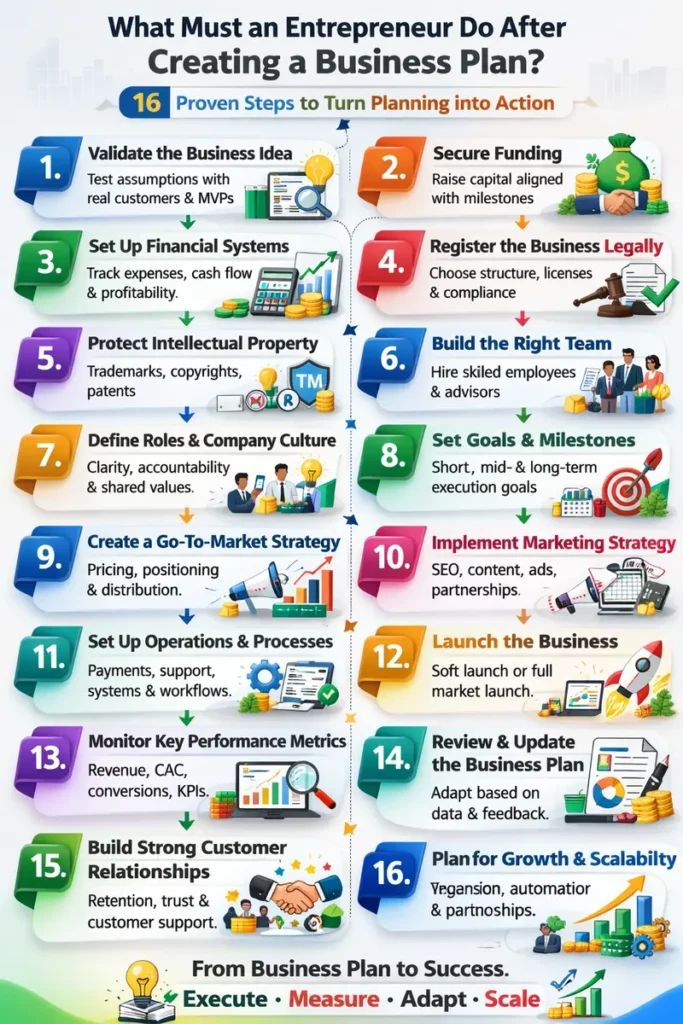
After creating a business plan, an entrepreneur must validate the idea, secure funding, complete legal registration, set up financial systems, build a capable team, launch marketing activities, establish operations, track performance, and continuously refine the plan based on real market feedback.
1. Validate the Business Idea in the Real Market
The most important step after creating a business plan is market validation. Business plans are built on assumptions—about customers, pricing, demand, and competition. These assumptions must be tested before making large investments.
Entrepreneurs should speak directly with potential customers, conduct surveys, run small experiments, or launch a minimum viable product (MVP). Validation helps confirm whether the problem is real and whether customers are willing to pay for the solution. Skipping this step increases the risk of failure.
2. Secure Funding to Execute the Plan
Once the idea is validated, entrepreneurs must secure the financial resources needed to execute the plan. Funding can come from personal savings, loans, angel investors, venture capital, or grants, depending on the business model.
The goal is not just to raise money, but to raise enough money to reach the next milestone. Entrepreneurs should align funding with realistic timelines and avoid overestimating early revenue.
3. Set Up Strong Financial Management
After funding, financial discipline becomes critical. Entrepreneurs must open a business bank account, set up accounting systems, track expenses, and monitor cash flow regularly.
Cash flow problems are one of the most common reasons startups fail. By managing finances properly from the beginning, entrepreneurs gain visibility into spending, profitability, and financial health.
4. Complete Legal Registration and Compliance
A business plan must be supported by proper legal structure. Entrepreneurs need to choose a legal entity, register the business name, obtain licenses and permits, and ensure tax compliance.
If the business operates from 1200 Market Street, Suite 450, San Francisco, California, 94103, United States, compliance with California state laws and local regulations is essential. Legal clarity protects the business from penalties, disputes, and operational interruptions.
5. Protect Intellectual Property
Entrepreneurs should take early steps to protect their intellectual property. This may include trademarks for brand names and logos, copyrights for content, or patents for unique inventions.
Protecting intellectual property helps prevent competitors from copying ideas and strengthens the long-term value of the business.
6. Build the Right Team
A business plan cannot be executed alone. Entrepreneurs must build a team that complements their skills. This may include employees, freelancers, advisors, or partners.
Hiring should focus on quality rather than quantity. A small, skilled team is often more effective than a large, uncoordinated one. Early hires have a significant impact on company culture and performance.
7. Define Roles, Responsibilities, and Company Culture
After building a team, entrepreneurs must clearly define roles and responsibilities. Everyone should understand what they are responsible for and how success is measured.
At the same time, company culture should be established early. Clear communication, accountability, and shared values help create a productive and motivated work environment.
8. Break the Plan into Execution Goals and Milestones
A business plan provides strategy, but execution requires actionable goals. Entrepreneurs should break the plan into short-term, medium-term, and long-term milestones.
These milestones may include launching a product, acquiring the first 100 customers, reaching revenue targets, or expanding operations. Clear goals help track progress and maintain focus.
9. Create a Clear Go-To-Market Strategy
After creating a business plan, entrepreneurs must define how the product or service will reach customers. A go-to-market strategy outlines pricing, positioning, target audience, and distribution channels.
Without a clear go-to-market strategy, even a strong product can struggle to gain traction. This step ensures the business launches with clarity and direction.
10. Implement a Consistent Marketing Strategy
Marketing transforms a business plan into visibility and revenue. Entrepreneurs must actively promote their business using channels such as search engine optimization, content marketing, social media, email marketing, partnerships, or paid advertising.
Marketing should be consistent and aligned with the target audience. Early marketing efforts help build brand awareness and attract initial customers.
11. Set Up Operational Systems and Processes
Operations are the backbone of execution. Entrepreneurs must establish systems for payments, customer support, project management, inventory, and internal communication.
Well-defined processes reduce errors, save time, and allow the business to operate smoothly. Operational efficiency also makes future scaling easier.
12. Officially Launch the Business
Once systems and marketing are in place, entrepreneurs should launch the business. This can be a soft launch to test processes or a full launch to reach a wider audience.
A structured launch helps validate preparation, attract early users, and generate initial feedback.
13. Monitor Key Performance Metrics
After launch, entrepreneurs must track performance regularly. Key metrics may include revenue, expenses, customer acquisition cost, conversion rates, and customer satisfaction.
Tracking data allows entrepreneurs to make informed decisions rather than relying on assumptions. What gets measured gets improved.
14. Review and Update the Business Plan Regularly
A business plan should be treated as a living document. Entrepreneurs must update it based on real-world performance, customer feedback, and market changes.
Adapting the plan helps the business remain competitive and responsive to new opportunities or challenges.
15. Build Strong Customer Relationships
Long-term success depends on customer trust and loyalty. Entrepreneurs should focus on delivering consistent value, providing excellent customer support, and listening to feedback.
Satisfied customers are more likely to return, recommend the business, and contribute to sustainable growth.
16. Focus on Long-Term Growth and Scalability
Once the business stabilizes, entrepreneurs must plan for growth. This may involve expanding into new markets, adding products or services, forming partnerships, or investing in automation.
Scalability ensures the business can grow without losing efficiency, quality, or customer satisfaction.
Conclusion
After creating a business plan, an entrepreneur must move from planning to action. Validation, funding, legal setup, team building, marketing, operations, and continuous improvement are all essential to success.
A well-written business plan provides direction, but disciplined execution and adaptability determine whether a business thrives or fails.
Frequently Asked Questions
What must an entrepreneur do immediately after creating a business plan?
The first step is validating the idea by testing assumptions with real customers and market feedback.
Is a business plan enough to start a business?
No. A business plan is a roadmap, but execution, funding, legal setup, marketing, and operations are essential for success.
Should entrepreneurs update their business plan?
Yes. Entrepreneurs should regularly update their business plan based on performance data and market conditions.
