



Artificial intelligence is no longer a futuristic concept—it’s the backbone of modern business, creativity, and productivity. In 2026, AI platforms have evolved from experimental tools into full-scale ecosystems that power everything from customer service automation to advanced data science and content creation.
But with hundreds of options available, choosing the right AI platform can feel overwhelming. To simplify your decision, we tested and analyzed dozens of tools based on usability, features, scalability, performance, and real-world value. This guide breaks down the 18 top AI platforms in 2026, helping you understand which ones are worth your time and investment.
What Makes a Great AI Platform in 2026?

Before diving into the list, it’s important to define what separates a great AI platform from the rest. In our testing, the best platforms shared a few key qualities:
- Ease of use: Clean interfaces and low learning curves
- Scalability: Suitable for both individuals and enterprises
- Integration capabilities: Works seamlessly with existing tools
- Performance: Fast, accurate, and reliable outputs
- Customization: Flexibility to adapt to different workflows
- Value for money: Strong ROI based on pricing and features
With these criteria in mind, here are the standout platforms shaping AI in 2026.
1. OpenAI Platform
One of the most widely recognized AI ecosystems, OpenAI continues to dominate in natural language processing, coding assistance, and multimodal AI applications. It powers chatbots, virtual assistants, research tools, and enterprise automation systems.
Its strength lies in versatility and API accessibility, allowing developers to build highly customized applications.
2. Google AI Studio
Google’s AI ecosystem has matured into a powerful platform for multimodal intelligence. It combines text, image, audio, and video processing in a unified environment.
It is especially valuable for organizations already using Google Cloud services, offering seamless integration and strong data infrastructure.
3. Microsoft Azure AI
Microsoft’s AI platform is a leader in enterprise-grade solutions. It offers machine learning tools, cognitive APIs, and automation services.
Its biggest advantage is security and compliance, making it ideal for industries like finance, healthcare, and government.
4. Amazon SageMaker
Amazon’s machine learning platform remains a top choice for developers and data scientists. It simplifies model building, training, and deployment at scale.
While powerful, it is best suited for technical users who require deep customization and control over ML workflows.
5. IBM Watson
IBM Watson continues to evolve as a trusted enterprise AI solution. It specializes in data analysis, business intelligence, and natural language understanding.
It is widely used in industries that require high reliability and structured decision-making.
6. Anthropic AI Platform
Anthropic has gained attention for its focus on safe and aligned AI systems. It emphasizes responsible outputs, making it popular among enterprises concerned with ethical AI deployment.
It is especially strong in conversational AI applications.
7. Hugging Face
Hugging Face remains the leading open-source AI hub. It provides thousands of pre-trained models and tools for natural language processing and machine learning.
Its open ecosystem encourages experimentation and community-driven innovation.
8. Runway AI
Runway is a creative-focused AI platform specializing in video generation, editing, and multimedia production.
It has become a favorite among filmmakers, designers, and content creators looking to streamline production workflows.
9. Midjourney
Midjourney is one of the most advanced AI image generation tools available. It produces highly artistic and detailed visuals from simple text prompts.
It is widely used in design, advertising, and digital art creation.
10. Stability AI
Stability AI focuses on open generative models, particularly in image generation. Its open approach gives users more control and flexibility compared to closed systems.
It appeals to developers and researchers seeking transparency.
11. Notion AI
Integrated directly into the Notion productivity ecosystem, Notion AI enhances note-taking, documentation, and workflow management.
It helps users summarize content, generate ideas, and automate writing tasks.
12. Jasper AI
Jasper is a leading platform for marketing and content generation. It is widely used for blog writing, ad copy, email campaigns, and brand messaging.
Its templates and workflow tools make it beginner-friendly and efficient.
13. Copy.ai
Copy.ai focuses on fast content generation for marketing teams. It helps users quickly produce social posts, product descriptions, and email sequences.
Its simplicity makes it ideal for small businesses and startups.
14. Synthesia
Synthesia enables AI-generated video creation using avatars and voiceovers. It eliminates the need for cameras, studios, or actors.
It is widely used in corporate training, marketing, and educational content.
15. Pictory
Pictory converts text-based content into short, engaging videos. It is particularly useful for repurposing blog posts and long-form content into social media clips.
Its automation features make video creation fast and scalable.
16. DataRobot
DataRobot is a powerful automated machine learning platform. It helps organizations build predictive models without requiring deep data science expertise.
It is commonly used in finance, healthcare, and retail analytics.
17. Zapier AI
Zapier integrates AI into workflow automation. It connects thousands of apps and enables intelligent automation between them.
It is ideal for improving productivity and reducing manual tasks across teams.
18. Canva AI
Canva AI combines design tools with generative AI capabilities. Users can create visuals, presentations, social media posts, and branding materials effortlessly.
Its accessibility makes it one of the most widely used creative platforms.
Key Insights from Our Testing
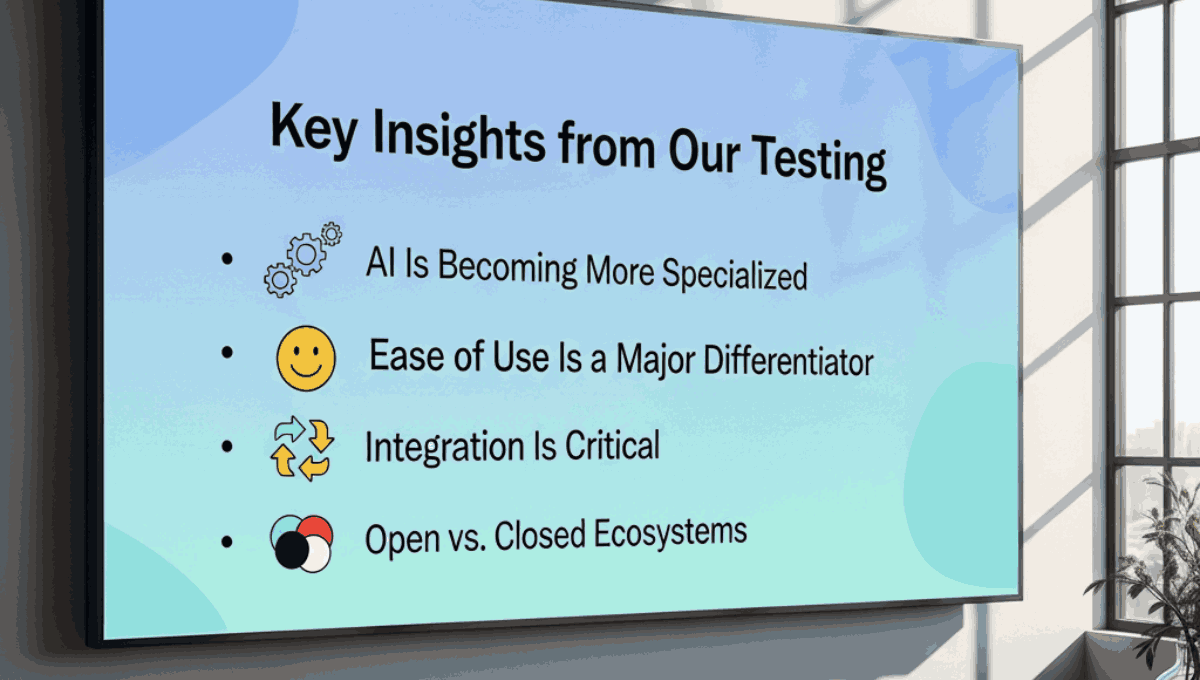
After evaluating these platforms, several trends became clear:
1. AI Is Becoming More Specialized
While early AI platforms aimed to do everything, today’s tools are more focused. Some excel in content creation, others in data science, and others in automation.
2. Ease of Use Is a Major Differentiator
Platforms that prioritize user experience are gaining traction, especially among non-technical users.
3. Integration Is Critical
The best AI platforms don’t operate in isolation—they connect seamlessly with other tools, making them more valuable in real workflows.
4. Open vs. Closed Ecosystems
There’s a growing divide between open-source platforms (flexible but complex) and closed platforms (user-friendly but less customizable).
How to Choose the Right AI Platform
Selecting the right AI platform depends on your specific needs. Here’s a quick guide:
- For developers: Look for platforms with strong APIs and customization options
- For businesses: Prioritize scalability, security, and integration
- For marketers: Focus on content generation and automation tools
- For creatives: Choose platforms with strong visual and multimedia capabilities
- For beginners: Opt for user-friendly platforms with guided workflows
Final Thoughts
The AI landscape in 2026 is more powerful and accessible than ever before. Whether you’re building applications, creating content, or automating workflows, there’s an AI platform tailored to your needs.
The key is not to chase the most advanced tool—but to choose the one that aligns best with your goals, skill level, and workflow. As AI continues to evolve, staying informed and adaptable will be your biggest advantage.
If you’re just getting started, pick one platform from this list and explore its capabilities deeply. Mastery of a single tool often delivers more value than surface-level use of many.
