


Executive Summary (TL;DR for Decision-Makers)
November 2025 was not just another update cycle — it marked a structural turning point in search.
At the center of this shift is Google’s evolution from search engine to answer engine.
Key realities:
- AI Overviews significantly reduced organic click-through rates
- Google Search Console introduced branded segmentation and future-dated annotations
- Google Business Profile added scheduling and multi-location publishing
- Gemini 3 began powering AI Mode
- Agentic booking moved search from navigation to transaction
The implication is clear:
Clicks are declining.
Influence is not.
If your SEO strategy still revolves around rankings and traffic growth alone, you’re optimizing for a world that no longer exists.
SEO in 2026: From Rankings to Authority in the Age of AI & Agentic Search
Google is no longer a search engine.
It is an answer engine.
AI Overviews and agentic booking systems now synthesize information and complete actions directly inside search results.
Users no longer:
- Browse 10 blue links
- Compare multiple blog posts
- Click through informational content
Instead, they:
- Ask a question
- Receive a summarized answer
- Take action instantly
This is the foundation of Answer Engine Optimization (AEO).
The Shift: From Search Engine to Action Engine
Search behavior has fundamentally changed.
Old Model:
User → Search → Click → Website → Convert
New Model:
User → Search → AI Summary → Action (Book / Call / Buy)
Clicks are optional.
Conversions are not.
The evolution accelerated when Gemini 3 began powering AI Mode, enabling:
- Advanced reasoning
- Multimodal understanding
- Agentic task execution
- Interactive response formats
Search is no longer about discovery.
It is about resolution.
Google Search Console: Smarter Attribution & Brand Clarity
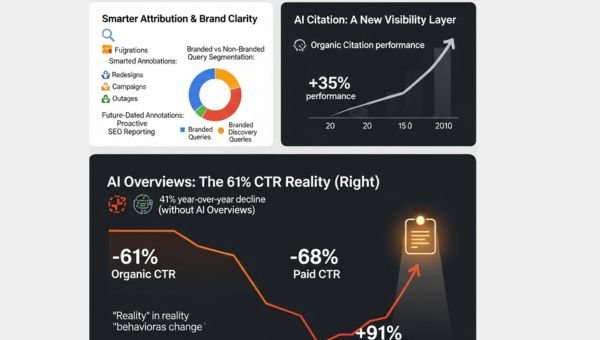
Google Search Console introduced two major updates that signal this strategic shift.
1. Future-Dated Annotations
Teams can now:
- Log planned migrations
- Schedule redesign launches
- Mark campaign rollouts
- Document expected outages
This moves SEO reporting from reactive to proactive.
Strategic impact: Stronger performance storytelling and cleaner attribution modeling.
2. Branded vs Non-Branded Query Segmentation
Google introduced AI-powered branded segmentation inside Search Console.
You can now directly measure:
- Branded queries
- Non-branded discovery queries
In an AI-driven environment, branded demand is becoming a defensive moat.
If traffic declines, the real question is:
Is discovery shrinking — or is brand demand weakening?
Now you can measure that precisely.
AI Overviews: The 61% CTR Reality
A large-scale study by Seer Interactive analyzed over 3,000 informational queries.
Findings:
- Organic CTR dropped ~61% when AI Overviews appeared
- Paid CTR dropped ~68%
- Even without AI Overviews, CTR declined 41% year-over-year
This is not a temporary fluctuation.
It reflects behavioral change.
However, brands cited inside AI Overviews saw:
- +35% organic performance
- +91% paid performance
A new visibility layer has emerged:
AI citation.
The Agentic Future: When Google Becomes the Checkout
AI systems are no longer just answering questions.
They are completing transactions.
AI Mode now integrates booking systems including:
- OpenTable
- Resy
- Booking.com
- Expedia
Search behavior is transitioning from:
Search → Website → Checkout
To:
Search → Checkout
If Google is the checkout counter, your website is the warehouse.
Your infrastructure must be synced.
Google Business Profiles: The New Storefront
Google Business Profile now supports:
- Scheduled posts
- Multi-location publishing
But this is bigger than convenience.
In an AI-driven ecosystem:
Google is the marketplace.
Google is the assistant.
Google is the checkout.
Your Business Profile is no longer a directory listing.
It is revenue infrastructure.
Metrics for the New Era: Measuring Success Beyond Clicks
Clicks alone no longer define success.
In 2026, SEO reporting must emphasize influence, authority, and assisted intent.
Core Metrics That Now Matter
| Metric | Why It Matters | How to Track |
| Brand Search Volume | High-intent branded searches indicate your brand is becoming the answer in the user’s mind. | Search Console, Google Trends |
| AI Visibility / Citation Rate | Being cited in AI Overviews is the new Position 0. | Manual SERP audits, AI tracking tools |
| Assisted Conversion Rate | AI visibility influences early-stage decisions. | GA4 Assisted Conversions, CRM tracking |
| Cluster-Based Share of Voice | Authority is built across topics, not isolated keywords. | Ahrefs / SEMrush cluster dashboards |
The New Reporting Mindset
Shift from:
Rankings → Authority
Clicks → Influence
Keywords → Topic Clusters
A 5% increase in branded search volume can outperform a 20% increase in low-intent traffic.
Answer ownership is the new competitive advantage.
Brand Is the Only Moat AI Cannot Replace
Here is the hard truth:
In 2026, your brand is the only “link” that AI cannot replace.
Algorithms can synthesize information.
They cannot synthesize trust, preference, or the specific intent of a user typing your name into the box.
If someone searches your brand, Google cannot intercept that intent.
That is insulation from algorithm volatility.
That is power.
Double Down on Schema: The Technical Advantage
Structured data is now the semantic handshake between your website and AI systems powered by Gemini.
Prioritize:
- Article Schema
- FAQ Schema
- Product Schema
- Organization Schema
- LocalBusiness Schema
Use clean JSON-LD implementation.
Semantic clarity improves:
- AI extraction probability
- Rich result eligibility
- Entity recognition
Unstructured content risks invisibility.
Immediate Action Plan
If this feels overwhelming, start here.
Step 1: Entity Foundation Audit
Audit your Organization Schema.
Does it define:
- Business entity
- Logo
- Contact points
- Social profiles (SameAs)
Goal: Ensure Google recognizes your brand as a distinct authority.
Step 2: Citation Gap Analysis
Identify your top 10 informational queries.
Manually check:
- AI Overview presence
- Sources carousel inclusion
- People Also Ask visibility
If absent:
- Improve structure
- Add concise answer blocks
- Strengthen FAQ schema
Goal: Make your content answer-ready.
Step 3: Transactional Friction Test
Search your primary service on mobile.
Ask:
- Can users book without visiting your site?
- Are booking links active?
- Is Product Schema synced?
Goal: Support zero-click conversion instead of resisting it.
Final Analysis: November 2025 Was a Structural Inflection Point
These updates collectively signal:
- AI reduces click dependency
- Brand authority protects performance
- Structured clarity determines visibility
- Direct transactions are increasing
- SEO reporting must evolve
This was not a routine algorithm refinement.
It was the beginning of search as an AI-driven action engine.
The businesses that treat their digital presence as an AI-optimized product — not just a website — will dominate.
The rest will keep chasing rankings.
Frequently Asked Questions (FAQ)
1. What was the November 2025 Google algorithm update about?
The November 2025 update marked a structural shift in how Google Search operates. Rather than focusing purely on ranking adjustments, the update accelerated AI-driven features like AI Overviews, branded query segmentation in Google Search Console, and transactional integrations in AI Mode. It signaled a move from search engine behavior to answer and action engine functionality.
2. Did AI Overviews reduce organic traffic?
Yes. A study by Seer Interactive found that organic click-through rates dropped by approximately 61% when AI Overviews appeared. However, brands cited within AI Overviews experienced improved performance, suggesting that visibility and citation are becoming more important than raw clicks.
3. How does Gemini 3 impact search results?
Gemini 3 powers AI Mode in Google Search, enabling advanced reasoning, multimodal understanding, and agentic task completion. This means search results are increasingly synthesized answers rather than link lists, and in some cases, Google can complete bookings or transactions directly within search.
4. What is Agentic Search or Agentic Booking?
Agentic search refers to AI systems that don’t just provide answers but complete actions. For example, Google now integrates with platforms like OpenTable and Booking.com to allow users to book reservations directly from search results without visiting a website.
5. Why is branded search becoming more important?
In an AI-driven environment, branded search acts as a defensive moat. When users search specifically for your brand, Google cannot intercept that intent with generic AI summaries. Branded demand reflects trust, recognition, and preference — which are resistant to algorithm volatility.
6. How should SEO reporting change after the November 2025 updates?
SEO reporting should shift from focusing only on rankings and traffic to measuring:
- Brand search volume
- AI citation rate
- Assisted conversions
- Topic cluster share of voice
Clicks alone no longer fully represent performance in an answer-engine environment.
7. How can businesses optimize for AI Overviews?
To improve visibility in AI Overviews:
- Implement structured data (Article, FAQ, Product, Organization schema)
- Use clear, concise answer blocks
- Strengthen entity clarity
- Improve topical authority across related keyword clusters
Structured clarity increases the likelihood of AI extraction.
8. Is Google Business Profile more important now?
Yes. Google Business Profile has evolved into a primary storefront within Google’s ecosystem. With scheduling features, multi-location publishing, and booking integrations, it plays a direct role in zero-click conversions and transactional search.
9. What Google updates happened in January 2026?
January 2026 focused on refining AI Overview accuracy and entity consistency. Google improved citation filtering to reduce hallucinated sources and strengthened brand entity validation signals. Early signs showed greater preference for clearly structured content using Organization and Article schema.
10. What changed in February 2026 in Google Search?
In February 2026, AI Mode enhancements powered by Gemini 3 expanded transactional integrations. More local service categories saw direct booking, call, and appointment actions directly within search results. This further reduced informational click-through rates but improved zero-click conversions for optimized profiles.
